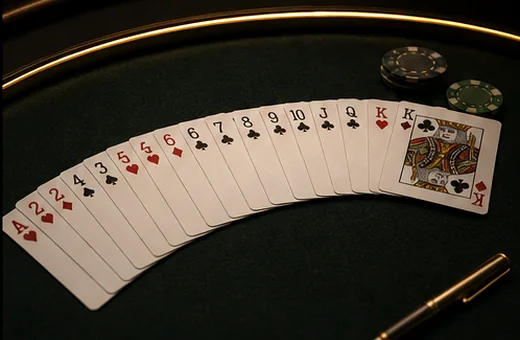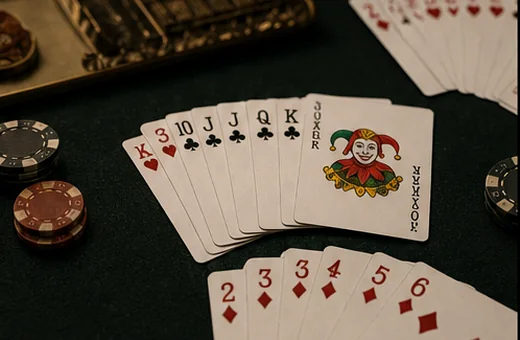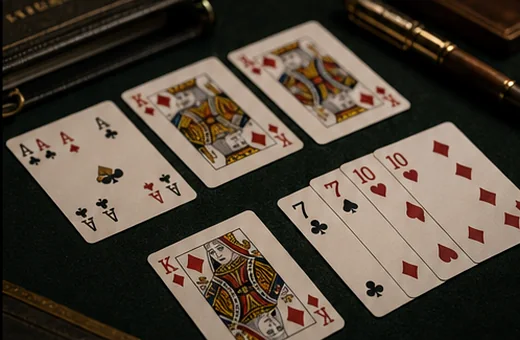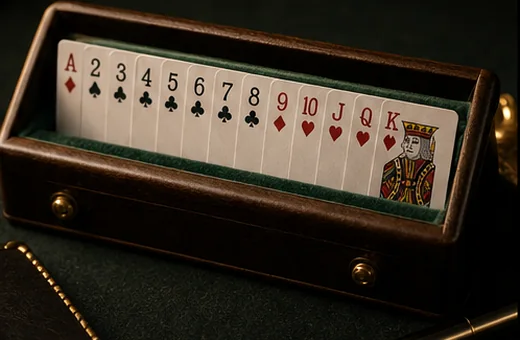
Declaration pattern
Can you declare Indian Rummy without making any set?
A set is useful, but it is not compulsory when all thirteen cards already belong to valid sequences.
Direct answer: Yes, under common 13-card Indian Rummy rules, a hand can be declared without a set if all thirteen cards form valid sequences. You still need at least two sequences, including at least one pure sequence. Count every card once and verify that no card is loose, duplicated between groups, or placed in a mixed-suit run.
Example of an all-sequence hand
| Group | Cards | Type |
|---|---|---|
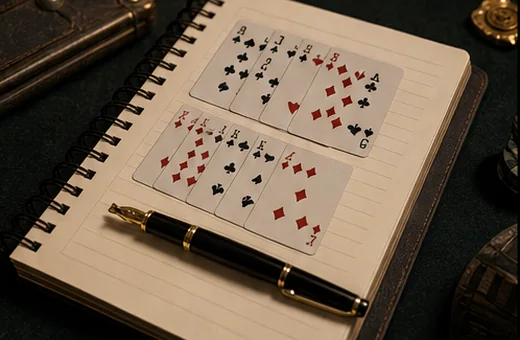
| 1 | 3♥ 4♥ 5♥ | Pure sequence |
| 2 | 7♣ 8♣ 9♣ | Pure sequence |
| 3 | 10♦ J♦ Q♦ | Pure sequence |
| 4 | A♠ 2♠ 3♠ 4♠ | Pure sequence |
Four checks before declaring
- Total the groups: they must account for all thirteen cards.
- Confirm at least one run has no joker.
- Keep each run in one suit and in consecutive rank order.
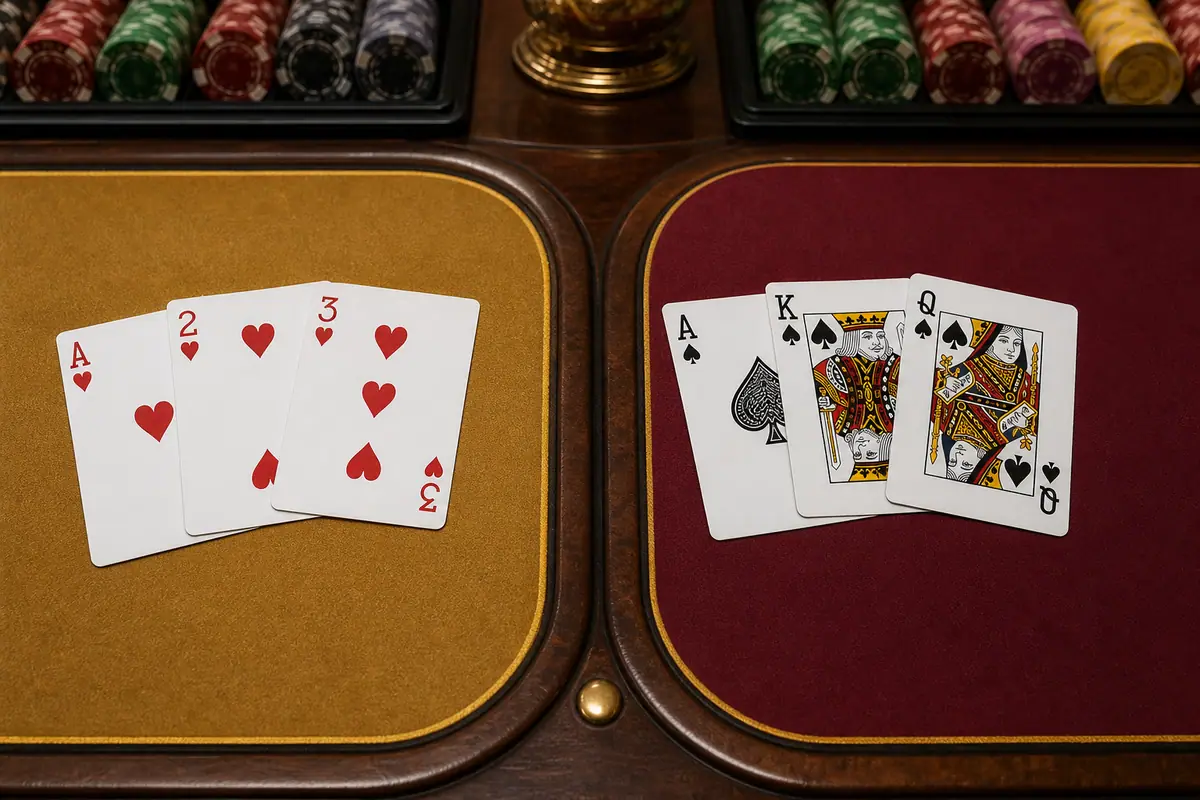
- Check the room’s ace rule before using A-2-3 or Q-K-A.
The reverse is not true: a hand made only of sets usually fails because it lacks the required sequences. “No set needed” never means “no sequence needed.”
Compare three possible hands
| Hand shape | Common result | Reason |
|---|---|---|
| Four legal runs | Can be valid | Required runs exist and all cards are grouped |
| Two legal runs + two sets | Can be valid | At least one run must be pure |
| Four sets, no run | Invalid | Required sequence structure is missing |
Watch the thirteen-card total
A common mistake is to display four attractive three-card runs and forget the thirteenth card. That loose card makes the declaration incomplete. Use one four-card run, or place the remaining card in a valid group, so the group lengths add up to exactly thirteen.
Another mistake is to create A♠-2♠-3♠ and Q♠-K♠-A♠ with a single A♠. One physical ace cannot appear in both groups. If the multi-deck hand contains two actual A♠ cards, keep the copies visibly separate and confirm the app’s grouping display.
Decision path when you have no set
- Mark the pure sequence first.
- Find a second run, pure or allowed impure.
- Test whether the remaining cards form one or more same-suit consecutive runs.
- If a card remains loose, do not declare; continue drawing and discarding.
- Submit only after the group lengths total thirteen.
An all-sequence hand is not automatically better than a mixed hand. The goal of this lesson is rule validation: choose the grouping that is legal and easiest to check, rather than forcing every card into a run.
Source and rule boundary
Pagat’s Indian Rummy rules describe a winning hand as combinations that include the required runs, allowing the rest to be additional runs or sets. House and app validation screens may use different terminology, so inspect their declaration preview.