Learn 13-Card Indian Rummy Rules & Pure Sequence
Learn 13-card Indian Rummy step by step with clear pure sequence, set, joker, declaration and scoring examples for adult free-social practice.
Site map
Use this crawlable index to reach every public BestRummyBonus route: rummy rules, APK download checks, bonus explainers, safety notes, support pages and troubleshooting blog articles.
182 crawlable pages
Learn 13-card Indian Rummy step by step with clear pure sequence, set, joker, declaration and scoring examples for adult free-social practice.
Crawlable BestRummyBonus site map with every rummy APK guide, rule article, safety note, support page and troubleshooting blog route.
101 Pool eliminates you when your running score reaches 101 or more. Each deal adds only your loss points — wins do not subtract on standard tables.
Same pool mechanics — only the elimination threshold changes. 101 ends faster; 201 suits longer multi-deal sessions.
13-card is the default online format; 21-card adds cards and stricter pure-sequence requirements.
201 Pool doubles the elimination line — longer sessions, more comeback room, same meld and declare rules as 101.
21-card Indian Rummy deals three extra cards and requires three pure sequences (or two pure plus wider set rules on some tables) — always read lobby meld requirements.
New 21-card players often mix up tunnels, dublees and 13-card set logic. Fix these patterns before your next social deal.
Walk through sample 21-card hands that satisfy tunnel, dublee and sequence rules before you tap declare on an app or show at a home table.
Printed jokers, wild jokers and cut-joker logic work differently in 21-card social play. Know substitution limits before you show.
Face values, tunnel bonuses and invalid-show penalties differ by house rules. Use this plain-language scoring map for adult social tables.
Seven-day Indian Rummy learning plan for beginners: rules, pure sequence, sets, jokers, observation, declare drill and social practice night.
A-2-3 Pure Sequence in Rummy — 13-card Indian Rummy rules with steps, card examples, limits and FAQ. Adult social practice only.
Plan an adult friends and family Rummy night: seating, deal rotation, no-cash points, breaks and 18+ social play boundaries.
No — printed jokers count as jokers. A pure sequence must be natural consecutive cards with zero jokers inside.
Yes — when wild joker rank matches the card printed on it, you may use it at face value in a pure sequence or set.
No — a pure sequence cannot contain any joker. If a joker sits inside the run, the group is impure at best.
can all remaining cards be Sets after two sequences in Indian Rummy — clear 13-card Indian Rummy answer with card examples, limits and related rules for adult social
No — a set needs three or four cards of the same rank across different suits. Two cards alone is an incomplete pair, not a meld.
On most tables you cannot pick from open and discard that same card immediately — you must discard a different card.
closed deck meaning in Indian Rummy — 13-card Indian Rummy rules with steps, card examples, limits and FAQ. Adult social practice only.
Drops in Deals transfer fixed chips to the winner — same timing windows as Points and Pool formats.
3-deal sample: start 80 chips each. Deal 1 win +25, Deal 2 lose 15, Deal 3 win +30 → finish 120 chips vs opponents.
Deals Rummy plays a fixed number of deals (2, 3, or 6). Chips move each deal; highest chip count at the end wins the table prize.
Deal scoring mirrors Points deadwood math — but transfers chips instead of instant rupees. Drops use fixed chip amounts.
Deals uses fixed rounds and chip stacks; Points settles each deal independently in rupees.
Deals ends on chip count after fixed deals; Pool eliminates players when running score crosses 101/201.
Declare meaning in Rummy Hindi: show, valid hand, declare button and social table phrases explained.
Each turn: pick one card from open or closed deck, then discard one — never skip the discard step.
Drop meaning in Rummy Hindi: first drop, middle drop, penalty points and when beginners should drop.
A dublee is a pair of two identical cards in 21-card Rummy. Dublees help finish a 21-card hand when tunnels or long sequences are still forming.
Leave the deal before your first pick — pay a small fixed penalty (often 20 points) instead of playing a hopeless hand.
First life is your pure sequence — the joker-free run you must build before any valid declare.
Free practice Indian Rummy vs real cash claims — what this site covers, safety boundaries and adult social play guidance without wagering promises.
Each deal awards chips from losers to winner based on point values. After the scheduled deals, the player with most chips takes the prize pool.
Every deal starts with one revealed rank — all cards of that rank become wild substitutes for the round.
Standard 13-card Indian Rummy deals exactly thirteen cards to each player at the start of every deal — never twelve or fourteen on classic tables.
On most tables one joker per impure sequence fills a single gap. Two jokers in a three-card run is usually rejected.
Most Indian Rummy tables seat two to six players per deal. Two-player and six-player family tables are both common — check the lobby label before you sit.
Unlike 13-card Rummy, many 21-card tables require three pure (joker-free) sequences before a valid declare.
You draw and discard toward valid melds. The winner's opponents pay deadwood points × table rate; drops pay fixed scores instead.
Re-sort after every pick — pure sequence left, second life next, sets right, deadwood last — so declare mistakes never sneak in.
A fixed sorting pattern saves seconds every turn — critical on timed app tables and lively home games.
how to calculate unmatched card points in Indian Rummy — 13-card Indian Rummy rules with steps, card examples, limits and FAQ. Adult social practice only.
Sort, verify two lives, group all 13 cards, then declare — one wrong group turns a win into maximum penalty.
Host a no-cash Indian Rummy game night: invites, rule sheet, score pad, snacks, stop time and responsible adult play checklist.
Sort by suit, find consecutive ranks, and lock a joker-free run before building sets or impure sequences.
Start a partial natural run and plug a joker into the gap — keep a separate pure sequence for declare.
Clear steps from deal to declare — pure sequence rule, draw-discard turns and card grouping examples for your first table.
Without a pure sequence your hand cannot declare. Build it before sets, before impure runs, before risky discards.
An impure sequence is a same-suit run where a joker substitutes a missing rank — valid meld but not your mandatory pure.
In five minutes learn the 13-card deal, pure sequence rule, set vs sequence, and draw-discard-declare loop.
Two 52-card decks plus printed jokers are shuffled; after the deal one rank becomes the wild joker.
Indian Rummy as a traditional social card game: family tables, festival nights, adult friends and no-cash point culture in India.
Build skill on free-practice tables and home nights without chasing cash claims. Focus on sequence discipline and discard reading.
Ungrouped cards cost face value — face cards and tens count 10, number cards count pip value, jokers usually zero when grouped.
Common 13-card Indian Rummy beginner mistakes: no pure sequence, invalid sets, early declare, joker misuse and fix checklist.
Indian Rummy etiquette for beginners: turn order, discard respect, no card flash, dispute handling and friendly table manners.
First drop exits before you pick from the deck; middle drop exits after your first pick. Penalties and strategy differ on most Indian Rummy tables.
Both are sequences, but first life must be pure while second life can use jokers — neither can be a set alone.
Indian Rummy four-card Impure Sequence examples — 13-card Indian Rummy rules with steps, card examples, limits and FAQ. Adult social practice only.
Indian Rummy Impure Sequence examples — 13-card Indian Rummy rules with steps, card examples, limits and FAQ. Adult social practice only.
Indian Rummy Impure Sequence practice quiz — 13-card Indian Rummy rules with steps, card examples, limits and FAQ. Adult social practice only.
Indian Rummy Impure Sequence with printed Joker examples — 13-card Indian Rummy rules with steps, card examples, limits and FAQ. Adult social practice only.
Indian Rummy invalid Impure Sequence examples — 13-card Indian Rummy rules with steps, card examples, limits and FAQ. Adult social practice only.
Jokers fill single rank gaps in same-suit runs — your typical second-life sequence after the pure run is set.
Pure sequences must be joker-free — no printed card, no wild rank substitute, no exceptions on standard tables.
Five quick joker scenarios — pure ban, impure fills, set substitutes, and wrong-show traps.
Indian Rummy meaning in Hindi: card game basics, 13-card format, social play context and key Hindi table words for beginners.
The objective is to arrange all 13 cards into valid sequences and sets with at least one pure sequence, then declare before opponents.
Observation and sequencing practice for Indian Rummy: connector drills, open-deck logs and pure sequence speed exercises.
Open deck and closed deck meaning in Hindi for Indian Rummy: pick rules, discard pile and stock pile terms.
Two joker types behave differently: one is a fixed deck card, the other is a rank role that rotates each deal — neither belongs in a pure sequence.
Pure and impure sequence meaning in Hinglish: joker-free run vs joker wali run with quick examples for Indian tables.
Indian Rummy Pure Sequence examples — 13-card Indian Rummy rules with steps, card examples, limits and FAQ. Adult social practice only.
Indian Rummy Pure Sequence practice quiz — 13-card Indian Rummy rules with steps, card examples, limits and FAQ. Adult social practice only.
Indian Rummy Pure Sequence requirement for declaration — 13-card Indian Rummy rules with steps, card examples, limits and FAQ. Adult social practice only.
Pure sequences use only natural consecutive cards in one suit; impure sequences add jokers to fill gaps. Only pure counts toward the mandatory declare requirement.
Indian Rummy rules hub — 13-card guides on pure sequence, sets, jokers, declare, scoring and beginner practice paths for adults.
Indian Rummy mein har khiladi ko 13 patte milte hain. Har baari draw-discard, kam se kam ek pure sequence ke saath declare.
Thirteen cards, two decks with jokers, one pure sequence minimum — here is the full beginner path without jargon.
Walk through three sample hands: a valid declare (0 loss), a dropped hand (fixed penalty), and a wrong declare (max penalty).
Indian Rummy Set with a printed Joker — 13-card Indian Rummy rules with steps, card examples, limits and FAQ. Adult social practice only.
When wild is 5, grouping 5♣5♦Wild-as-5♠ makes a valid set if wild represents another suit.
Both are valid sets when ranks match and suits differ. A four-card set uses all suits of that rank; a three-card set leaves one suit unused.
Turns move clockwise: draw one card from closed or open pile, optionally meld, then discard one face-up card.
Indian Rummy turn practice quiz — 13-card Indian Rummy rules with steps, card examples, limits and FAQ. Adult social practice only.
An invalid declare usually costs the maximum hand penalty 鈥?often 80 points on major apps 鈥?instead of your actual deadwood total.
A wrong show costs full penalty — missing pure sequence, stray cards, or illegal groups trigger instant invalid declare.
invalid Pure Sequence examples in Rummy — 13-card Indian Rummy rules with steps, card examples, limits and FAQ. Adult social practice only.
invalid Set examples in Rummy — 13-card Indian Rummy rules with steps, card examples, limits and FAQ. Adult social practice only.
No — K-A-2 is not a valid wrap-around sequence on standard Indian Rummy tables. Ace is either low with 2-3 or high with Q-K, never bridging king to two.
Joker card points in Indian Rummy — 13-card Indian Rummy rules with steps, card examples, limits and FAQ. Adult social practice only.
Sets group equal ranks across suits — a joker can stand in for the missing suit copy when table rules allow.
Joker meaning in Rummy Hindi: printed joker, wild joker, cut joker and substitution rules in plain Hindi.
Face cards and aces carry 10 points each; numbered cards carry face value; jokers carry zero when unmelded on most tables.
Fold after you've picked at least once — pay a middle penalty (often 40 points) instead of risking full deadwood or wrong show.
The open deck is the visible discard pile — pick only the top card, and every pick telegraphs information.
Open deck shows the last discard — closed deck hides your draw. Pick open when the top card helps; pick closed to protect information.
Try a free no-cash 13-card Indian Rummy learning room, then understand draw, discard, pure and impure sequences, sets, declaration and Indian card-game context.
New Points players often declare early, ignore pure sequence, or join high point values before learning drops.
Valid declare needs one pure sequence plus remaining valid groups. Tap declare only after arranging all 13 cards into melds.
On Points tables, first drop (before pick) and middle drop (after pick) replace deadwood math with fixed point charges — check your lobby card.
Use free tables to learn Points flow without wallet stress — same declare rules, zero or practice-chip stakes.
Sample hand: build pure sequence 4♥ 5♥ 6♥, set 9♠ 9♦ 9♣, impure 2♦ 3♦ Joker — discard leftover before declare.
Points Rummy finishes in one deal per table. Each card left unmelded costs its pip value multiplied by the rupee point value you joined.
Losing score = sum of deadwood card values (capped at 80 on many apps) × per-point rupee rate. Drops bypass deadwood and use fixed penalties.
Both use 13 cards and the same meld rules — Points Rummy settles each deal for cash/points; classic home play often tracks chips across informal rounds.
Beginners ignore running totals, skip drops near elimination, or re-enter without checking prize math.
Pool drops use fixed point adds — first drop before pick, middle drop after — same timing as Points but added to running pool score.
Sample 101 pool: Deal 1 lose 34 → total 34. Deal 2 lose 52 → total 86. Deal 3 lose 20 drop → total 106 → eliminated.
Re-entry lets an eliminated player rejoin the same pool for a fee, resetting or partially resetting their score — table rules define the exact reset.
Pool Rummy runs until a player's total crosses 101 or 201 points — each deal adds loss points to a running pool score.
Each deal adds loss points to your pool total — not multiplied by rupee rate like Points Rummy. Winner of the deal usually adds zero.
The deck's dedicated Joker card — how it substitutes in impure melds and why it never belongs in a pure sequence.
A pure sequence is three or more consecutive cards of one suit with no joker inside the run.
Pure vs impure sequence in 13-card Indian Rummy 鈥?definitions, valid examples, joker limits and declare rules for adult learners.
Q-K-A Pure Sequence in Rummy — 13-card Indian Rummy rules with steps, card examples, limits and FAQ. Adult social practice only.
Practice grouping 13-card Rummy hands: sample deals, meld targets, pure sequence drills and set stacks for beginners.
Run this list before every declare — one skipped step turns a win into an 80-point wrong show.
Memorize a 13-card Rummy declare checklist: pure sequence, card count, joker roles, set validity and two-second show habit.
Every discard and open-deck pick tells a story. Train your eye on free-practice tables before you rely on guesswork.
Watch every open-deck discard — dead cards you hold become safer discards; hot ranks opponents pick signal their melds.
One turn error — wrong open recycle, skip re-sort, or rush declare — can cost 80 points or hand the game.
Hand distance in Indian Rummy: count cards needed to finish, when to drop, and completion signals for declare timing.
Jokers in valid melds score zero — left ungrouped, printed jokers usually stay at zero while wild cards may count at natural rank value.
Practice Rummy with friends using virtual points: chip values, score app alternatives, reset rules and weekly leaderboards without cash.
Rummy printable score sheet layout for casual play: player rows, deal columns, drop penalties and running totals for home tables.
Private table rules for friends Rummy: joker policy, drop penalties, time per turn, redeal triggers and no-cash boundary.
Manual score math: add deadwood face values, apply 80 cap, compare drop and wrong-show fixed rows — apps auto-calc in live play.
Screen-time rules for adult Rummy groups: app session limits, phone-down dealing, break timers and balanced social play.
Spot valid sets fast — same rank, different suits, no duplicate suit traps. Practice before you declare on live tables.
Rummy strategy myths vs facts for Indian players: guaranteed wins, lucky discards, joker hoarding and evidence-based practice tips.
Rummy vs Rami vs Remi: English, Hindi and European spellings for the same card-meld family — which term fits Indian 13-card rules.
Rummy vs Rammy spelling: correct English spelling, common India typos, search terms and which word to use in rules content.
After first life (pure), second life is your other required sequence — impure with joker is fine.
Sequence meaning in Rummy Hindi — 13-card Indian Rummy rules with steps, card examples, limits and FAQ. Adult social practice only.
A set is three or four cards of the same rank across different suits — not a sequence. Here is how sets work beside your pure sequence.
Set meaning in Rummy Hindi: same rank different suits, valid examples, invalid duplicate suit patterns.
Sequences need consecutive ranks in one suit; sets need matching ranks across different suits. You need both types plus a pure sequence to declare.
Three-deal format adds one buffer round — common on mobile apps for balanced session length.
Home tables teach negotiation and house rules; apps teach speed, auto-validate declares and timed sorting — best practice combines both without cash pressure.
In 21-card Rummy a tunnel is three identical cards — same rank and same suit. Tunnels are powerful melds but table rules decide how many you need before a show.
two sequences required in Indian Rummy — 13-card Indian Rummy rules with steps, card examples, limits and FAQ. Adult social practice only.
Two-deal tables finish in minutes — one bad deal can still be recovered in deal two if meld luck turns.
All 13 cards grouped, one pure sequence, a second sequence, nothing left unmatched — that is a winning show.
valid Set examples in Rummy — 13-card Indian Rummy rules with steps, card examples, limits and FAQ. Adult social practice only.
No stock left — most apps declare a tie and redeals; some tables reshuffle the open deck minus top discard.
When the cut card shows a printed joker, most tables pick a backup wild rank — often all Aces become wild for that deal.
One rank becomes wild each deal — every card of that rank substitutes in impure melds until the round ends.
A wrong declare usually costs the maximum hand penalty — often 80 points in 13-card Indian Rummy — plus you lose the deal outright.
21 card Rummy FAQ — searchable 13-card Indian Rummy answers on pure sequence, sets, jokers, declare and scoring. Adult social practice only.
Contact BestRummyBonus for Indian Rummy rules help, APK download questions and site feedback. Adult free-social practice support only.
Deals Rummy FAQ — searchable 13-card Indian Rummy answers on pure sequence, sets, jokers, declare and scoring. Adult social practice only.
Quick answers on 13-card deal, pure sequence, sets, jokers and declare — the most common beginner questions in one searchable board.
Points Rummy FAQ — searchable 13-card Indian Rummy answers on pure sequence, sets, jokers, declare and scoring. Adult social practice only.
Pool Rummy FAQ — searchable 13-card Indian Rummy answers on pure sequence, sets, jokers, declare and scoring. Adult social practice only.
Learn why one physical card cannot count in two Indian Rummy groups, with a corrected 13-card grouping example.
Learn whether both required Indian Rummy sequences may be pure, with valid card examples and a declaration checklist.
See when a 13-card Indian Rummy hand made only of sequences can be declared, with a complete four-run example.
See how three or four sequences can form a valid 13-card Indian Rummy hand and what must still be pure.
Learn which open-deck card can normally be drawn in Indian Rummy and why buried discard cards stay unavailable.
Learn the minimum length of a pure sequence and how longer same-suit runs work in 13-card Indian Rummy declarations.
See how many decks a 13-card Indian Rummy table commonly uses for two, three, four or five players, with a clear house-rule check.
Browse all Indian Rummy rule articles on BestRummyBonus — joker guides, sequence lessons, declaration checks and 13-card practice notes for adults.
Check whether a Rummy app bonus claim is safe by reviewing source, terms, age scope, KYC, wallet control and support evidence.
Two joker types behave differently in 13-card Indian Rummy melds — which can fill gaps, pure sequence limits and declare examples for adults.
A safety-first Hinglish guide for readers asking real cash games kaise khele, with Rummy terms, age, KYC and no-guarantee boundaries.
Fix Rummy APK install and update failures caused by parse errors, signature conflicts, low storage, blocked permissions or unsafe mirror files.
Fix Rummy app auto-back crashes and 99% loading loops on low-end Android phones with cache, RAM, storage and verification-required reinstall checks.
Check Rummy app bonus code terms, expiry, account limits and support evidence before using a code in any third-party app.
Learn how to read Rummy bonus app claims, practice offers and terms without assuming cash-out, winnings or operator approval.
Read Rummy cash game terms, wallet rules, KYC boundaries and withdrawal evidence before trusting cash-game claims.
Fix Rummy KYC name mismatch issues by comparing profile, PAN, Aadhaar, bank account and mobile details without editing identity data.
Understand Rummy location restriction messages, account risk signals and compliant next steps without VPN bypass or multi-account tactics.
Fix Rummy OTP delivery delays on Jio, Airtel or Vi by checking DND, SIM state, SMS routing, app cache and resend timing.
Troubleshooting articles for Indian Rummy app status issues, OTP delivery, location restrictions, low-end phones, APK installs and KYC checks.
Learn why a Rummy withdrawal may show returned, failed or delayed, and what evidence to check before contacting operator support.
Learn when Indian Rummy sequences are normally revealed and how app grouping differs from showing cards to opponents.
Learn what commonly happens when the first face-up discard is a joker and why the first player must check table rules.
Understand the rare Hand-Rummy first-turn declaration rule, its card condition and why many apps do not use it.
A beginner-safe Indian Rummy checklist for deciding whether an open-deck card helps a sequence, set, or only adds deadwood.
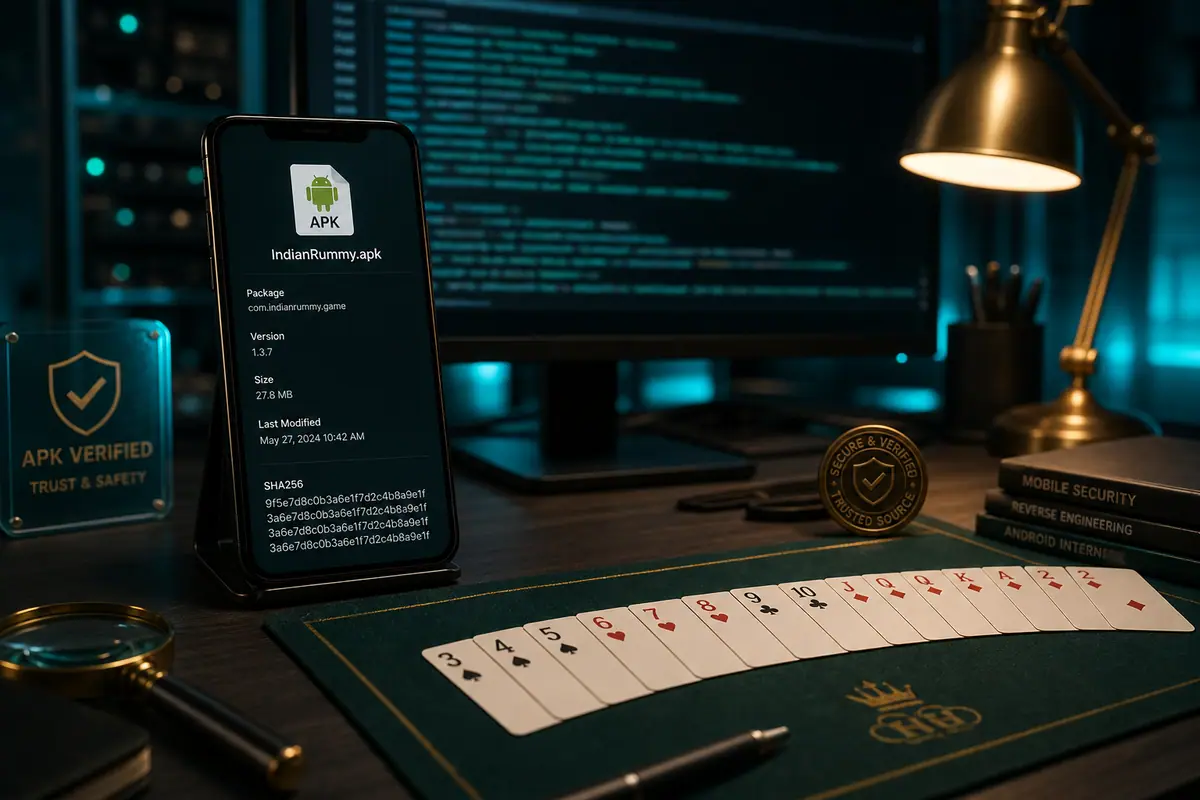
Dark felt, gold verification cues and realistic Indian Rummy card groups support the rule lesson on this page.