Card grouping
How many cards can a pure sequence have in Indian Rummy?
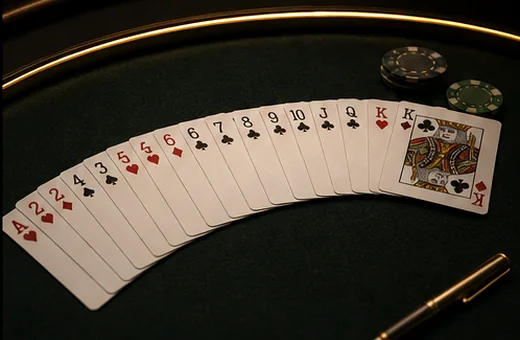
Three cards is the usual minimum; a longer consecutive same-suit run can remain one pure sequence.
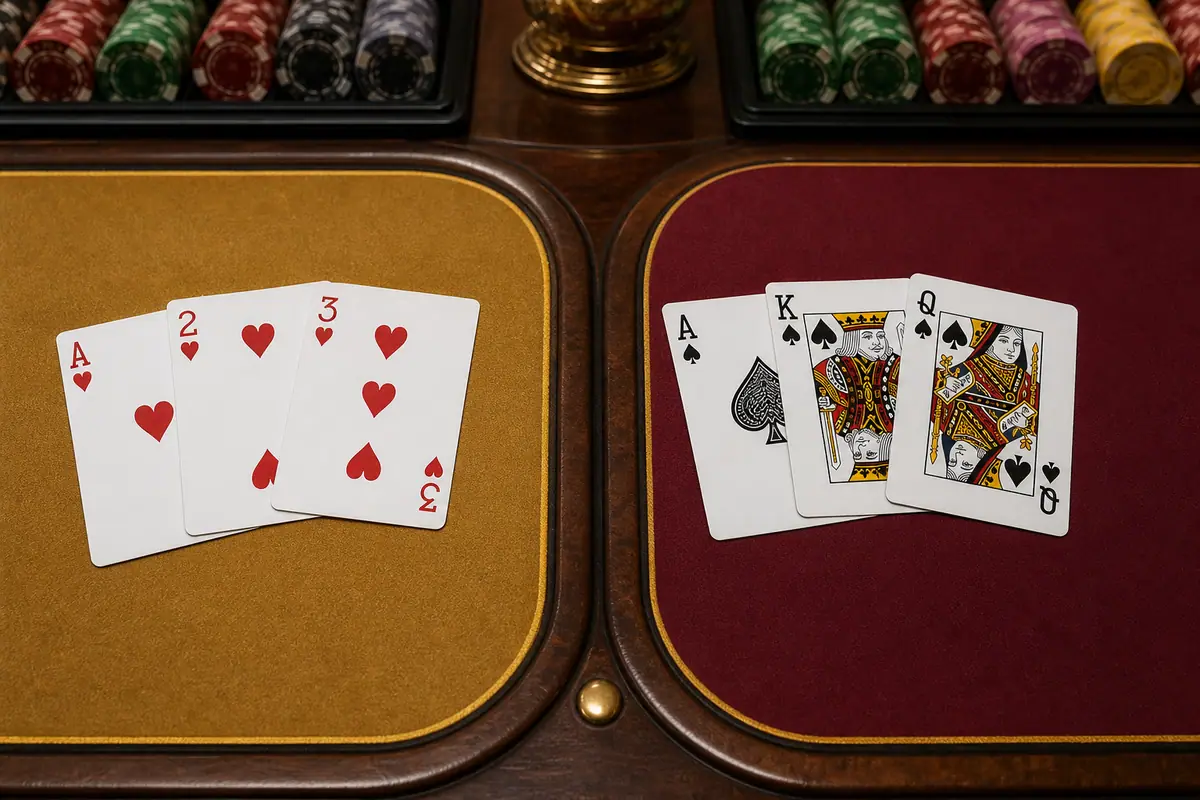
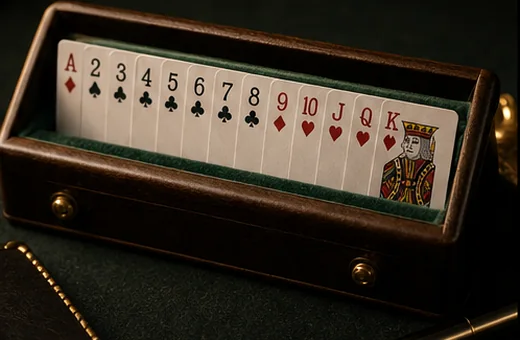
Direct answer: A pure sequence normally contains at least three consecutive cards of the same suit and no substituted joker. It may contain four, five, or more cards when the ranks stay consecutive. In a 13-card hand, the practical maximum is limited by the cards you hold and by the need to complete the rest of the declaration.
Valid and invalid lengths
| Cards | Status | Reason |
|---|---|---|
| 6♣ 7♣ | Not a sequence | Only two cards |
| 6♣ 7♣ 8♣ | Pure | Three natural consecutive cards |
| 6♣ 7♣ 8♣ 9♣ 10♣ | Pure | Long same-suit run |
| 6♣ 7♦ 8♣ | Invalid | Mixed suits |
Should you split a long run?
Sometimes a six-card run can be displayed as two three-card runs, but splitting is useful only if both groups remain legal and the room accepts the arrangement. Never split merely to hide an ungrouped card. The declaration screen must account for every card exactly once.
Ace boundary
Many tables allow A-2-3 and Q-K-A but not K-A-2. Because ace handling can vary, read the current room rule instead of assuming a wraparound sequence.
Long-run examples
3♦-4♦-5♦-6♦ is one four-card pure sequence. Extending it with 7♦ creates a five-card pure sequence; it does not turn into a set or require a joker. By contrast, 3♦-4♦-6♦-7♦ has a missing 5♦ and is not one continuous natural run.
A printed joker beside 3♦-4♦-6♦ can stand for 5♦ only if the room permits that substitution, producing an impure sequence. The number of cards is sufficient, but “pure” describes how the ranks are completed, not merely the length of the group.
When splitting helps
| Cards held | Possible display | Check |
|---|---|---|
| 2♣ 3♣ 4♣ 5♣ 6♣ 7♣ | One six-card run | Legal if all natural |
| 2♣ 3♣ 4♣ / 5♣ 6♣ 7♣ | Two three-card runs | Both remain legal |
| 2♣ 3♣ / 4♣ 5♣ 6♣ 7♣ | Two groups | First group is too short |
Length is not the only test
- Count at least three physical cards.
- Keep all cards in one suit.
- Check that every adjacent rank is consecutive.
- Confirm no substituted joker is present.
- Verify ace placement under the current table rule.
Do not stretch a long run merely to make it impressive. If moving one card helps complete a second required sequence or a legal set, compare both complete thirteen-card arrangements before declaring.
On a small screen, scroll the whole group before submission. A card clipped outside the visible row can make a five-card run look like four cards and cause an avoidable counting mistake.
Source and rule boundary
Pagat’s Indian Rummy overview describes straights of three or more consecutive cards in one suit. App-specific grouping and ace rules may be narrower.